A recently published market study confirms the assumption that the era of purely physical testing at proving grounds is slowly coming to an end. We are standing on the threshold of fundamental changes that are redefining the role of traditional proving grounds within the overall vehicle development process.
A new economy, new requirements and staffing challenges
Analysts at Frost & Sullivan predict that the number of proving grounds owned directly by OEMs will decrease over the next decade. The reasons are primarily economic and technological. As automotive consultant Shyam Raman notes, OEMs are striving for greater cost efficiency while simultaneously facing increasing difficulties in retaining technical staff in remote locations, a situation further exacerbated by corporate cost-cutting pressures. In addition, current shifts in consumer behaviour – with people working from home more frequently and no longer driving tens of thousands of kilometres per year – are leading to reduced emphasis on traditional durability and performance testing. This development strengthens the role of virtual testing.
At the same time, demand for simulations, digital twins and AI-driven virtual testing is rising sharply. A logical consequence is that manufacturers are actively seeking partnerships with private proving ground operators, such as ourselves, to optimise their operating costs. These partnerships are increasingly expanding to include non-traditional players – software providers and companies offering AI-based solutions.

Digital partnerships: how simulation complements physical testing
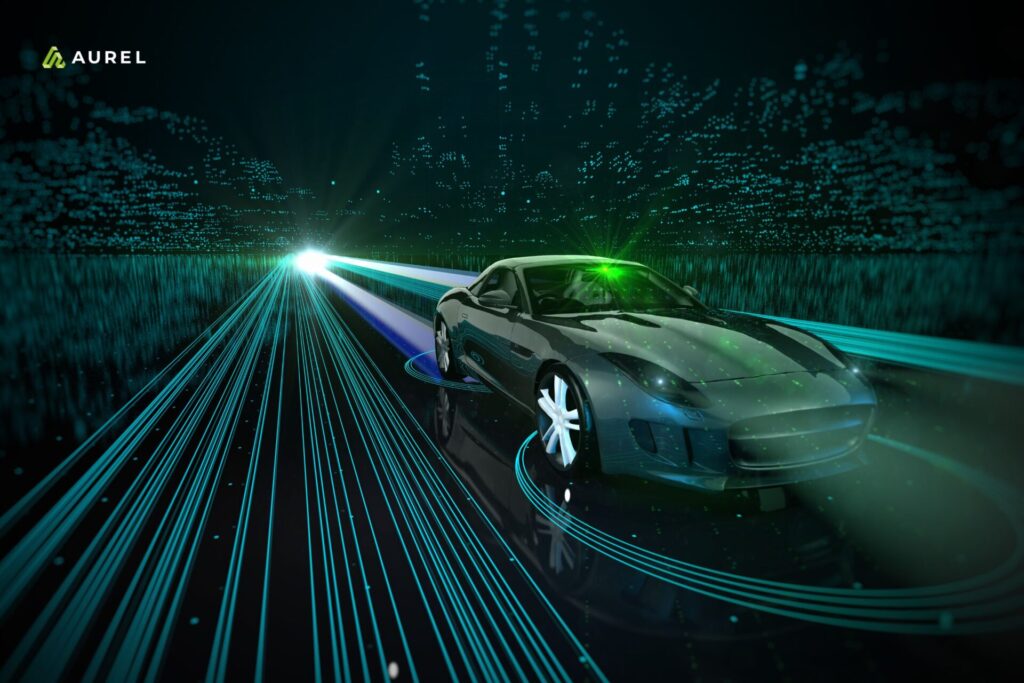
A key aspect of this transformation is the convergence of the physical and virtual worlds. Andrew Mathers from TRC clearly defined the relationship between these environments in the article. According to him, the virtual model is not an end in itself, but a tool that serves as a complement to physical testing. In other words, virtual simulations such as a digital twin of a proving ground allow engineers to carry out extensive digital testing across a wide range of permutations. Nevertheless, final validation is still required in a physical environment. This confirms the interdependence of both worlds.
This concept aligns closely with our vision at AUREL. As our colleague Zdeněk Svoboda, Head of the Development and Innovation Centre, has stated, the future of testing will be neither purely physical nor purely digital: “It will be hybrid and capable of leveraging the strengths of both environments.”
Our experience with the implementation of Vehicle-in-the-Loop (ViL) methodologies – testing a vehicle within a simulation loop – confirms that digital replicas of our facility, created for feasibility studies in a virtual environment, represent a key tool for optimising test sequences. This allows our partners to cover an almost unlimited number of scenarios digitally and to finalise validation of critical parameters on the physical proving ground. This approach significantly increases the volume of data obtained and improves engineering efficiency. We are also able to accept a physical vehicle together with a virtual scenario supplied by an OEM, carry out the test, fully document it and deliver comprehensive data for subsequent analysis, thereby accelerating the entire development cycle.

Localisation, modelling and data sharing between digital twins
The article also highlighted specific technical challenges that leading industry players are addressing and which we fully reflect in our own activities:
- Specialised locations and ViL: OEMs require smaller, more compact proving grounds focused on ADAS, connectivity and sensor calibration. Proving grounds are therefore being equipped for complex urban traffic simulation. For example, ARTC in Taiwan integrates V2V, V2I and RSU communication models with a 6DOF simulator to verify the integrated performance of sensor systems and decision-making logic.
- Model fidelity of difficult surfaces: Sean Connolly from Smithers emphasised that physical data remains essential for validating virtual models. Pressure to improve model fidelity is driving more extensive research into difficult-to-model surfaces such as mud, snow and ice. In this area, as well as in monitoring variations in adhesion on rubberised asphalt, it is necessary to continuously study physical characteristics and move towards more objective testing methods.
- Compatibility of digital twins: A major challenge identified by Milla Mäkelä from Lapland Proving Ground is the fact that most OEMs use their own proprietary software solutions. This often represents a technical barrier to communication between different digital twins and must be overcome for the technology to become practically usable for all manufacturers.
The future of automotive testing is being shaped in a hybrid environment. For us at AUREL, this means continuing to develop ViL methodologies and digital replicas while simultaneously investing in physical capacities for testing ADAS and critical sensor technologies. Although Frost & Sullivan sees a shift towards the virtual domain, it remains true that electric and autonomous vehicles still require extensive real-world testing.
This article is based on analyses and quotations presented in a professional article published in the November issue of Automotive Testing Technology International.